
Visibility Splays & Speed Surveys
Visibility & Speed Assessment for Safe Access
Visibility splays are the lines of sight at a junction that allow drivers to see approaching traffic. In planning terms, they are often the single most important factor in determining whether a site can be accessed safely and whether development is acceptable.
Drawing visibility splays requires technical knowledge and an understanding of highway guidance. The required visibility distance is directly linked to vehicle speeds, meaning higher speeds require greater visibility. Where walls, vegetation or boundary features restrict sightlines, this can quickly lead to highways objections or refusal.
I help architects, planning consultants and developers assess visibility requirements, establish realistic vehicle speeds and prepare compliant drawings with clear technical justification. Whether you need early feasibility advice or support responding to a highways objection, the focus is on keeping applications moving.
When Visibility Splays & Speed Surveys Are Required
If you stand at a junction and struggle to see vehicles approaching from the left and right, you may need my help with visibility splays. Common scenarios include:
New Access Points
New site accesses where visibility must be clearly demonstrated to satisfy highway authority standards and support planning approval.
Existing Access Changes
Existing accesses subject to increased traffic or change of use, requiring reassessment of visibility to ensure safe and compliant operation.
Development Schemes
Residential, commercial and industrial developments where visibility splays are required to demonstrate access is safe and acceptable.
Constrained Junctions
Sites affected by walls, hedges or boundary features that restrict visibility at access points, often requiring detailed assessment.
Rural Access Points
Rural sites using gates or informal access where visibility is limited due to road alignment, speed and lack of formal junction design.
Vegetation Constraints
Where vegetation encroaches into visibility splays, requiring assessment to ensure access meets highway authority standards.
What The Service Covers
My visibility splays and speed survey service combines visibility assessment, speed analysis and technical justification to demonstrate that site access meets highway authority requirements. The focus is on establishing realistic vehicle speeds, defining compliant visibility splays and providing evidence to support planning applications.
Speed Assessment
Establish the relevant speed limit and likely vehicle speeds based on site context, forming the basis for accurate visibility requirements and access design.
ATC Speed Surveys
Undertake ATC speed surveys using automatic traffic counters to record actual vehicle speeds and provide reliable data for visibility assessment.
Visibility Requirements
Determine required visibility splays using national standards, ensuring access design aligns with guidance and highway authority expectations.
Visibility Drawings
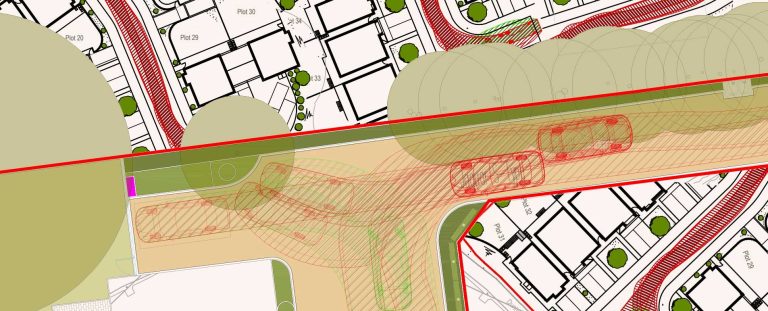
Prepare accurate visibility splay drawings using appropriate mapping data to support planning submissions and demonstrate compliance with standards.
Feasibility & Design Advice
Identify potential constraints and advise on boundary treatments or layout changes to improve visibility and achieve compliant access design.
Technical Justification
Provide technical justification and policy-based arguments to support access proposals and address highway authority concerns.
How Visibility & Speed Data Support Planning Applications
Highway authorities need visibility splays to show that vehicles can enter and leave a site safely. If the required visibility cannot be shown, the application may be refused.
Early visibility assessments identify problems before an application is submitted. This helps avoid abortive design work, reduces the risk of refusal and allows the project team to understand whether a site is realistically developable at an early stage.
Where necessary, I obtain and analyse speed data to establish actual vehicle speeds. While surveys introduce an additional cost and can add time, a unique part of my approach is to review Ordnance Survey speed data first as a sense-check. This provides an indication of likely vehicle speeds before commissioning a formal survey. Unlike many consultants, this avoids the cost and delay of an unnecessary speed survey where it is clear the results are unlikely to support the application.
I advise on practical, low-impact solutions such as boundary adjustments, vegetation management and minor layout changes to achieve compliance. I provide technical justification to support professional judgement and paint an access in the best light. Overall, the aim is simple: to remove highways risk from a project and provide the planning authority with clear evidence that the access arrangements are safe.
Early Risk Identification
Identify visibility constraints early, including restricted sightlines and speed-related issues, reducing the risk of objections and avoiding design work.
Accurate Speed Data
Establish realistic vehicle speeds using ATC speed surveys and automatic traffic counters, ensuring visibility requirements are based on reliable data.
Compliant Access Design
Demonstrate that access arrangements meet highway authority standards, with visibility splays designed to reflect site conditions and policy requirements.
Design Solutions
Identify solutions such as boundary adjustments or vegetation management to achieve compliance without unnecessary redesign or delay.
Related Transport Planning Services

Discuss Your Planning Project
If visibility at your site access is unclear or has been challenged, it’s worth addressing it early. I can assess the situation, establish realistic speed data and provide clear evidence to support your application.